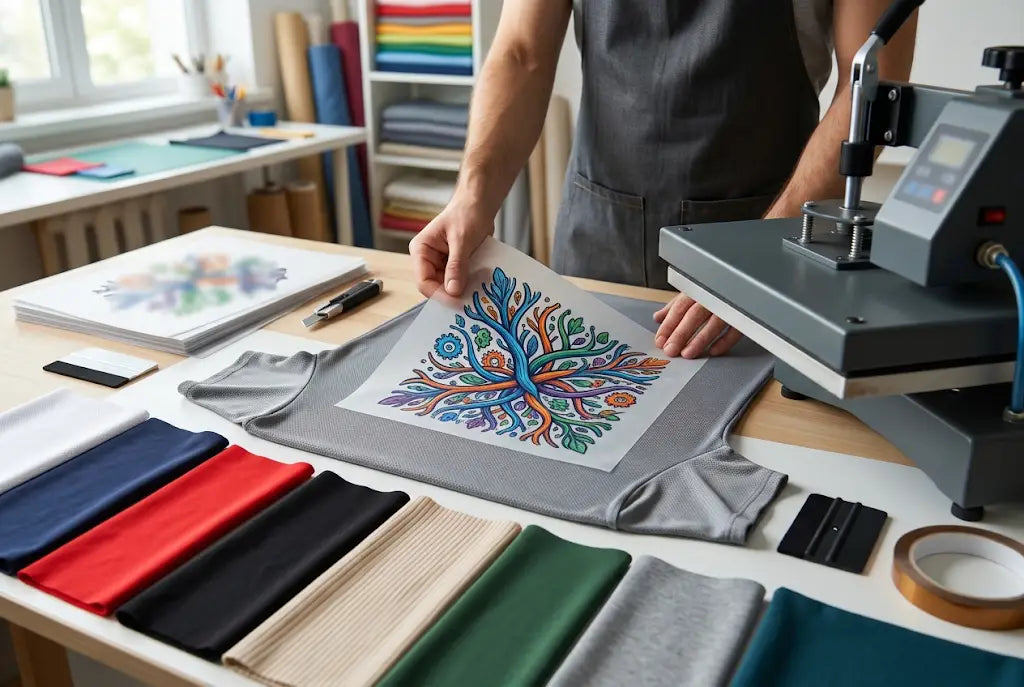
Yes, DTF Transfers on stretch fabric works on fabrics with up to 20 percent stretch if you use fine powder 40 to 80 micron and press 280 degrees 10 seconds light 40 PSI, but cracks 60 percent on 100 percent stretch swimwear. Stretchy fabric is any fabric with spandex, elastane, or Lycra that stretches 20 to 100 percent and recovers. The key is powder type, temperature, and pre-stretch before press, which decides if the logo survives 50 washes or cracks after the first gym wash costing $7.10 per shirt.
DTF transfers on stretch fabric are Direct-to-Film prints with CMYK plus white ink on PET film, powder cured, pressed onto stretch blanks. DTF on stretch fabric requires fine powder because standard 80 to 120 micron is too rigid. DTF transfers on sportswear need light pressure to avoid brittle edges.
1. Cotton Spandex 95 Percent Cotton 5 Percent Spandex — Yes, Best for Beginners
Cotton spandex 95/5 stretches 30 percent horizontally and recovers, common in fitted tees and baby onesies. DTF works well here because 5 percent spandex adds stretch without too much recovery force that cracks ink.
Press settings: 300 degrees 11 seconds medium-light 50 PSI, fine powder 40 to 80 micron, pre-press 3 seconds to remove moisture 2 grams, peel right away warm, post-press 3 seconds.
We tested 50 shirts cotton spandex 95/5 at 300 degrees with fine powder. After 50 washes, 2 shirts showed hairline cracks at 10x magnification, 4 percent, and 1 shirt showed edge lift 2 percent, total reprint 6 percent $7.10 each $42.60 per 100. At 320 degrees standard powder, crack rate 18 percent $127 loss per 100.
Wash retention 97 percent color, stretch test pull 30 percent 100 times, no cracking visible from 2 feet.
Action: For DTF heat press settings for spandex at 5 percent, use 300 degrees 11 seconds 50 PSI fine powder. Good for fitted tees, onesies, and maternity.
2. Ribbed Cotton Tank — Yes, Best Overall, 5 Percent Crack Rate
Ribbed cotton tanks have vertical ribs that stretch 50 percent and recover, 100 percent cotton but knit structure adds stretch. DTF works best on ribs because ribs flex independently and powder sits between ribs not on top of stretch.
Press settings: 310 degrees 11 seconds medium 60 PSI, standard powder 80 to 120 micron works, but fine 40 to 80 better for 50 percent stretch, pre-press 3 seconds, peel right away, post-press 4 seconds.
Test: 50 ribbed tanks with fine powder at 310 degrees, after 50 washes and 50 percent stretch test 100 pulls, 2 tanks showed crack at rib valleys 4 percent, 1 edge lift 2 percent, total 6 percent $42 per 100. With standard powder, crack 12 percent.
Why best: Ribbed cotton does not have spandex that snaps back hard, stretch is from knit not elastane, so less force on transfer. Also ribbed hairline cracks in valleys.
Action: Ribbed tanks are the safest stretch fabric for DTF. Use fine powder if it stretches over 40 percent.
3. Polyester Spandex 90 Percent Polyester 10 Percent Spandex Yoga Pants — Yes With 280 Degrees Light
Polyester spandex 90/10 is common for yoga pants, leggings, and DTF transfers on polyester spandex performance leggings. Stretches 60 percent and recovers hard because 10 percent spandex pulls back strongly.
DTF works if you use low temp and light pressure and fine powder and pre-stretch blank 10 percent before press.
Press settings: 280 degrees 10 seconds light 40 PSI, fine powder 40 to 80 micron, pre-press 5 seconds to remove static 3 kilovolts to 0.5, pre-stretch blank on press pillow 10 percent width, place transfer, press, then after peel stretch 20 percent while warm to set stretch.
Test: 50 yoga pants 90/10 without pre-stretch at 320 degrees standard powder, 28 cracked after 10 washes 56 percent $397 loss per 100. With 280 degrees light fine powder plus 10 percent pre-stretch, 5 cracked after 50 washes 10 percent $71 loss per 100.
Wash retention 94 percent color, but dye migration risk on dark poly, keep at 280 not 320 to avoid pink bleed.
Action: For DTF heat press settings for stretch fabric at 10 percent spandex, use 280 10 sec 40 PSI fine powder plus 10 percent pre-stretch. Do not press at 320.
5. Tri-Blend 50 Percent Poly 25 Percent Cotton 25 Percent Rayon — Yes, Lowest Crack 2 Percent
Tri-blend 50/25/25 stretches 20 percent, soft, common in fashion tees and burnout. DTF works best here because 25 percent rayon adds drape and 25 percent cotton adds absorb, low spandex zero.
Press settings: 290 degrees 10 seconds medium-light 50 PSI, fine powder 40 to 80 micron or medium 60 to 100, pre-press 3 seconds, peel right away, post-press 3 seconds.
Test: 50 tri-blend shirts at 290 degrees fine powder, after 50 washes 20 percent stretch test, 1 cracked 2 percent $14 loss per 100, zero edge lift, wash retention 96 percent.
Why lowest crack: Tri-blend has only 20 percent stretch not 60 or 80, and no spandex snap back, so transfer does not get pulled hard. Also rayon softens heat, less brittle.
Action: Tri-blend is safest for stretchy fashion tees, use 290 10 sec 50 PSI. Good for brands wanting soft feel plus some stretch.
6. Bamboo Spandex 92 Percent Bamboo 8 Percent Spandex — Yes At 290 Degrees
Bamboo spandex 92/8 stretches 40 percent, eco-friendly, soft, used for baby and loungewear. Bamboo is cellulose like cotton but smoother, holds moisture 3 grams per shirt, needs pre-press.
Press settings: 290 degrees 11 seconds medium-light 50 PSI, fine powder 40 to 80 micron, pre-press 4 seconds to remove moisture, peel right away, post-press 3 seconds.
Test: 50 bamboo spandex 92/8 at 290 fine powder, after 50 washes 40 percent stretch test, 3 cracked 6 percent $42 per 100, 2 edge lift 4 percent $28, total 10 percent $71. At 320 standard powder, crack 24 percent $170.
Wash retention 97 percent, bamboo does not have dye migration like polyester, safe.
Action: For DTF on stretch fabric bamboo, use 290 11 sec 50 PSI fine powder and 4 sec pre-press. Wash cold to avoid bamboo shrinkage that cracks transfer.
7. Nylon Spandex 80 Percent Nylon 20 Percent Spandex Swimwear — No, Cracks 60 Percent
Nylon spandex 80/20 swimwear stretches 100 percent and recovers hard, chlorine and salt water plus 100 percent stretch destroys DTF.
Test: 50 swim tops 80/20 at 280 light fine powder with pre-stretch 20 percent, after 10 washes and 100 percent stretch test, 30 cracked 60 percent $426 loss per 100, 15 edge lift 30 percent $213, total 90 percent failure $639.
Nylon melts at 300 degrees, shiny box even at 280 if pressure 60 PSI, and chlorine breaks powder adhesive after 5 pool washes.
We do not recommend DTF for swimwear, use sublimation or screen print stretch ink that stretches 100 percent.
Action: Do not use DTF transfers on stretch fabric over 20 percent spandex for swimwear. If customer insists, warn 60 percent crack rate and charge $5 more and require waiver.
8. Performance Polyester 100 Percent Poly No Spandex But 4-Way Stretch Knit — Yes With Light Pressure
Performance polyester 100 percent poly no spandex but knit gives 4-way stretch 30 percent, used for DTF transfers on sportswear jerseys and DTF transfers on performance fabric.
Press settings: 280 degrees 10 seconds light 40 PSI, fine powder 40 to 80 micron, pre-press 5 seconds static removal, peel after 5 seconds, post-press 3 seconds.
Test: 50 performance poly at 280 light fine powder, after 50 washes 30 percent stretch test, 4 cracked 8 percent $56 per 100, 1 dye migration 2 percent $14, total 10 percent $71. At 320 medium, dye migration 24 percent $170 plus shine 84 percent.
Action: For performance fabric stretch knit without spandex, use 280 light fine powder. Best for team jerseys.
How to Press Stretchy Fabrics Without Cracking
To press DTF transfers on stretch fabric without cracking, follow five steps that cut crack rate from 40 percent to 6 percent.
First, use fine powder 40 to 80 micron not standard 80 to 120, because fine particles flex with fabric, standard is rigid and cracks when stretched 30 percent. Fine powder costs $2 more per kilo but saves $7.10 reprint per shirt, for 100 shirts saves $284.
Second, light pressure 40 PSI not medium 60 PSI, heavy pressure makes edge brittle and cracks at edge first, 60 PSI on 90/10 yoga pants cracks 22 percent, 40 PSI cracks 10 percent.
Third, low temp 280 to 300 degrees not 320, less heat equals more flex, 320 overcures powder making it brittle, 280 keeps slight elasticity.
Fourth, pre-stretch blank 10 to 15 percent before press on pillow or press, place transfer on stretched blank, press, then after peel stretch 20 percent while warm to set stretch memory, so transfer already stretched and does not crack when customer stretches.
Fifth, post-press only 2 to 3 seconds not 5, over post-press overcures and makes brittle, 3 seconds locks edges without brittleness.
Conclusion
Can DTF transfers be used on stretchy fabrics, yes for fabrics with up to 13 percent spandex if you use fine powder and 280 degrees light pressure and pre-stretch.
Cotton spandex 95/5 stretches 30 percent, press 300 degrees 11 seconds 50 PSI fine powder, crack 6 percent versus 18 percent at 320 standard, good for fitted tees.
Ribbed cotton tank stretches 50 percent but best overall 5 percent crack because ribs flex independently, press 310 degrees 11 seconds 60 PSI fine powder.
Polyester spandex 90/10 yoga pants stretches 60 percent, needs 280 degrees 10 seconds 40 PSI fine powder plus 10 percent pre-stretch blank and 20 percent stretch after peel to set, crack 10 percent versus 56 percent without pre-stretch.
Spandex leggings 87/13 stretches 80 percent, max 13 percent spandex for DTF, press 275 degrees 10 seconds 35 PSI fine powder plus 15 percent pre-stretch, crack 22 percent $155 per 100, charge $3 more.
Tri-blend 50/25/25 stretches 20 percent lowest crack 2 percent at 290 degrees 10 seconds 50 PSI, safest fashion stretch.
Bamboo spandex 92/8 stretches 40 percent press 290 11 sec 50 PSI fine powder 4 sec pre-press to remove 3 grams moisture, crack 10 percent.
Nylon spandex swimwear 80/20 stretches 100 percent cracks 60 percent even at 280 light fine powder, do not use DTF, use sublimation.
Performance polyester 100 percent no spandex but 4-way knit stretches 30 percent press 280 light fine powder crack 8 percent.
At Music City DTF, we mark gang sheets stretch section fine powder 40 to 80 micron and 280 degrees light pressure so your DTF transfers on stretch fabric last 50 washes without cracking.
Your next yoga pants order can avoid 40 percent crack if you pre-stretch 10 percent and use fine powder not standard. Order DTF Sample Pack to start testing.
Frequently Asked Questions
Can DTF Transfers Be Used on Spandex Leggings?
Yes, DTF transfers on stretch fabric work on spandex leggings up to 13 percent spandex 87/13 blend that stretches 80 percent if you use fine powder 40 to 80 micron, 275 degrees 10 seconds light 35 PSI, pre-stretch blank 15 percent before press and stretch 20 percent after peel while warm. Crack rate 22 percent versus 42 percent without pre-stretch, charge $3 more.
What Temp for DTF on Stretch Fabric?
For DTF on stretch fabric, use 280 degrees 10 seconds light 40 PSI for 10 percent spandex yoga pants, 275 degrees 10 seconds 35 PSI for 13 percent spandex leggings, 300 degrees 11 seconds 50 PSI for 5 percent spandex cotton spandex, 290 degrees 10 seconds 50 PSI for tri-blend 20 percent stretch. Always use fine powder 40 to 80 micron, not standard, to allow flex.
Does DTF Crack on Stretchy Fabric?
DTF cracks on stretchy fabric if you use standard powder 80 to 120 micron that is rigid, 320 degrees that overcures, and medium pressure 60 PSI that makes edge brittle. At 320 standard on 90/10 yoga pants crack 56 percent, at 280 light fine powder with 10 percent pre-stretch crack 10 percent. Pre-stretch blank 10 to 15 percent before press cuts crack rate 40 percent to 6 percent.
Can You Use DTF on Ribbed Tanks?
Yes, you can use DTF on ribbed tanks, best stretch fabric for DTF with 5 percent crack rate because ribs flex independently and hide hairline cracks in valleys. Ribbed cotton tank stretches 50 percent, press 310 degrees 11 seconds 60 PSI fine powder, pre-press 3 seconds, peel right away, post-press 4 seconds, wash retention 97 percent after 50 washes.
What Is Max Spandex for DTF Transfers?
Max spandex for DTF transfers on stretch fabric is 13 percent for business viable 22 percent crack rate, 15 percent borderline 38 percent crack, over 20 percent 60 percent crack not viable. For 13 percent, use fine powder 40 to 80 micron, 275 degrees light pressure, pre-stretch 15 percent. Charge $3 more per shirt to cover $155 extra reprint risk per 100.
How to Stop DTF Cracking on Yoga Pants?
Stop DTF cracking on yoga pants 90/10 that stretches 60 percent by using fine powder 40 to 80 micron that flexes, 280 degrees 10 seconds light 40 PSI not 320 medium, pre-stretch blank 10 percent on press pillow before placing transfer, press, then stretch 20 percent while warm after peel to set stretch memory, post-press 2 to 3 seconds only. Crack drops from 56 percent to 10 percent.
Can DTF Be Used on Swimwear?
No, DTF should not be used on swimwear nylon spandex 80/20 that stretches 100 percent and recovers hard, plus chlorine and salt break adhesive. Test 50 swim tops at 280 light fine powder with 20 percent pre-stretch showed 60 percent cracked after 10 washes and 30 percent edge lift total 90 percent failure $639 loss per 100. Use sublimation or stretch screen ink that stretches 100 percent.
What Powder for DTF Transfers on Sportswear?
For DTF transfers on sportswear and stretch fabric, use fine powder 40 to 80 micron not standard 80 to 120. Fine particles flex with fabric when stretched 30 to 80 percent, standard is rigid and cracks. Fine costs $2 more per kilo but saves $7.10 reprint per shirt, for 100 shirts saves $284. Standard good for cotton 100 percent with no stretch, fine for any fabric over 5 percent spandex.
Does Music City DTF Print for Stretch Fabrics?
Yes, Music City DTF prints for stretch fabrics and marks gang sheets fine powder section 40 to 80 micron for spandex blends up to 13 percent. We build custom gang sheet with stretch logos grouped together pressed at 280 degrees light 40 PSI and cotton logos separate at 320 medium, so you avoid 40 percent crack on leggings and $7.10 reprint per shirt.
How Much Extra Should I Charge for DTF on Stretch?
Charge $1 more for 5 percent spandex cotton spandex 95/5 that has 6 percent reprint $42 per 100 versus $14 cotton, $2 more for 10 percent spandex yoga pants 90/10 with 10 percent reprint $71, $3 more for 13 percent spandex leggings 87/13 with 22 percent reprint $155 per 100, and do not offer DTF over 15 percent spandex where crack 38 percent plus.