Most conversations about print quality miss the point completely.
It’s not about whether a print “looks good.”
It’s about whether it looks identical every single time it leaves the shop.
That’s where Hyper Color 9 Version comes in.
We’re talking about an advanced Direct-to-Film setup that uses a 9-color ink gamut instead of the standard 5-color system. Not a replacement. Not a downgrade or upgrade story either. Just a different level of control; the kind brands care about when their identity depends on color staying locked across every product drop.
And yes, standard DTF still runs most of the industry. No issue there. This shift is happening at the top end, where consistency starts to matter more than raw output.
The real reason Hyper Color 9 Version exists in the first place
Nobody asked for more colors because printing was broken or failing in the traditional sense. The reality is, standard DTF already works well for most production needs. The demand for more channels came when brand identity started getting more controlled and visually strict across platforms.
A red logo is no longer just “red” in modern branding. It shifts slightly warmer on hoodies, a bit deeper on black garments, and appears brighter or softer under different lighting in product photography. These differences are subtle but noticeable at premium pricing levels.
Bulk customers often won’t care about that drift, but brands selling at higher margins absolutely do because consistency directly impacts perceived value. Hyper Color 9 Version expands the color gamut so these small tonal shifts are reduced. It doesn’t replace DTF; it simply gives more headroom before color accuracy starts to break under real production conditions.
What actually changes inside the print process
Here’s the part most people misunderstand. Hyper Color 9 Version isn’t simply “more ink for better prints,” and that idea is an oversimplification of what’s actually happening in production environments. What it really does is shift how tones are constructed. Instead of relying only on CMYK + white to build every shade, the system adds extra ink channels that fill in missing tonal steps between colors.
That becomes important in three key areas: skin tones in photographic prints, gradients in illustration-heavy artwork, and brand logos that rely on very specific Pantone-like accuracy. Standard systems can reproduce all of these, no doubt, but they do it through approximation and blending.
The 9-color setup reduces how much approximation is needed. Less guesswork during RIP processing means fewer corrections, tighter output consistency, and more stable production runs over time.
Why premium brands are quietly moving toward it
This isn’t a loud shift, and it’s not something heavily advertised in the broader printing market. It usually shows up quietly inside production conversations rather than marketing materials. Operators start asking things like, “Why does this red look slightly off on black hoodies after a second run?” or “Can we keep the same tone consistent across all SKUs without micro-adjustments every time?” or even, “Why did the sample feel cleaner than the bulk production batch?”
That gap between what was approved and what gets reproduced at scale is exactly where Hyper Color 9 Version starts getting attention. Not because standard DTF is failing in any major way, but because premium brands don’t tolerate small variations the same way.
From what we’ve seen in real shop environments, teams don’t describe it as suddenly getting better prints. They describe it as finally stopping the random surprises between runs, which is often the real pain point in scaling production.
Where standard DTF still absolutely makes sense
This part needs to be clear because it often gets misunderstood in discussions around upgraded ink systems. Standard DTF is still widely used across the industry for very practical reasons. It is reliable in day-to-day production, fast enough for high-volume turnaround, cost-efficient for tight-margin work, widely supported across most printers and RIP setups, and perfectly capable of handling bulk apparel jobs without issues. There is no scenario where standard DTF is being pushed out or replaced in general production environments.
In fact, most shops are better off staying on standard systems if their business model is centered around volume production, if they are not working with strict brand-level color matching requirements, or if speed and throughput matter more than fine tonal control. Hyper Color 9 Version simply enters the conversation when expectations shift from “getting the job done efficiently” to “keeping color identity consistent across every single output.”
This is not a better-or-worse comparison in real shop terms. It is more accurately a question of what is being produced, at what price point, and for what kind of customer expectation.
What changes on the production floor when you switch
The shift is not dramatic at first glance. On the surface, nothing about the shop feels different. Printers still run on the same schedule, film still cures at the same temperature range, and the heat press still behaves exactly the way operators expect it to. The core workflow doesn’t change, which is why many shops don’t notice anything immediate after switching.
But once production settles in, operators start picking up on smaller, more practical differences that only show up in day-to-day work. There are fewer second-guess edits inside RIP software because color output doesn’t drift as often between runs. There’s less back-and-forth during color correction because the system holds closer to expected values on the first pass. Output also becomes more stable across different production days, even when small environmental changes like humidity or room temperature fluctuate.
Another noticeable change is reduced variation between sample prints and full production batches. What gets approved is much closer to what actually gets produced at scale, which removes a common friction point in apparel printing workflows.
One thing that consistently stands out in real shop environments is that decision fatigue drops. When color behavior becomes predictable, operators spend less time constantly adjusting and re-checking files, and more time simply running production. At that point, they stop “fixing” things that were never actually broken in the first place.
Cost reality (what shops actually feel, not marketing numbers)
Let’s be practical about what this actually costs in a real shop environment, because this is where most discussions drift into assumptions instead of numbers.
A full DTF setup capable of handling expanded color systems typically sits in the same general investment bracket as mid-tier production equipment. In most real-world setups, you’re looking at entry-to-mid production printers ranging roughly from $3,800 to $9,500, depending on brand, print width, and configuration. RIP software is usually an additional $350 to $1,200, depending on whether you’re running basic licensing or more advanced color management tiers.
Ink is where people often overthink the difference. Standard systems are generally lower per liter, while 9-color expanded gamut setups sit slightly higher due to additional channels and formulation complexity. But in practice, this isn’t a dramatic jump. Most shops see it as a manageable incremental increase per liter, not a cost shock.
The part that actually matters is not the upfront or per-liter difference.
Where money really shifts is not ink cost. It’s reprints.
If color consistency improves even slightly across batches, the financial impact shows up in very practical ways:
- fewer rejected prints that never make it to shipping
- fewer customer complaints tied to “color not matching what was expected”
- fewer revision cycles when mockups don’t match final output
That’s where ROI actually builds over time. Not in the ink line item, but in how often you have to redo work that should have been finished the first time.
A real shop transition (composite case from production data)
A small apparel print shop in Austin was running standard DTF for streetwear drops and Etsy orders. They weren’t dealing with failures or major print defects. On paper, everything looked fine. The real issue showed up in consistency across different releases.
Same logo. Different hoodies. Slight color drift.
Nothing that would outright ruin a print, but enough that customers paying premium pricing started noticing differences between drops. One batch would feel slightly warmer, another slightly cooler, and another just a touch off in contrast depending on fabric and run conditions.
Like most shops in that situation, they tried the usual fixes first: recalibrating RIP profiles, swapping PET film batches, and adjusting white ink density to stabilize underbase behavior. Each adjustment helped temporarily, but none of it solved the inconsistency long-term. The variation kept creeping back in across production cycles.
When they moved to a Hyper Color 9 Version system, the change wasn’t immediate perfection, and it didn’t eliminate every variable in the workflow. But the difference became noticeable over time. The variation between production runs started to tighten, and output became more predictable from one batch to the next.
Within a couple of months, they saw fewer customer complaints tied to print appearance, less rework spent correcting color drift after test runs, and smoother repeat production of the same designs without constant recalibration.
What actually changed wasn’t operator skill or attention to detail. It was the level of control the system gave them over how color behaved across repeat production.
Where UV DTF fits into this conversation
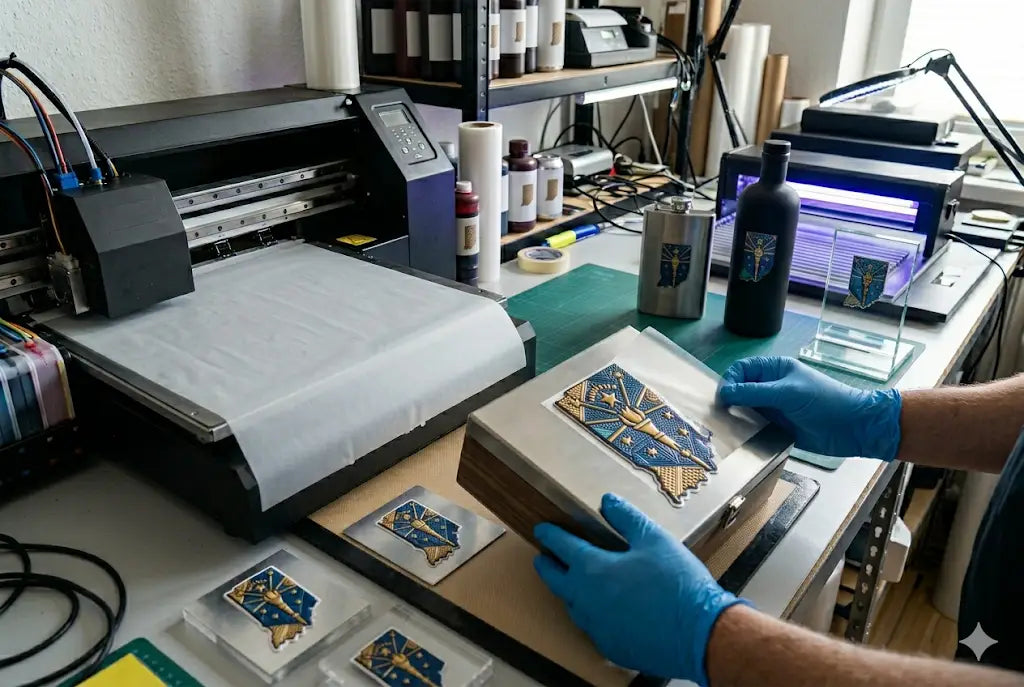
In UV DTF applications, expanded color systems tend to stand out even more clearly in real production environments. Unlike fabric, hard surfaces don’t give you any visual “forgiveness” when color shifts even slightly between runs.
On materials like acrylic, coated glass, packaging surfaces, and rigid labels, color accuracy is immediately visible at first glance. There’s no weave, stretch, or fabric texture to soften or disguise small variations in tone, contrast, or saturation. What you print is exactly what the customer sees under direct lighting.
That’s why UV DTF workflows tend to adopt or evaluate gamut expansion earlier than apparel-focused shops. The tolerance for inconsistency is much lower, especially when prints are used for branding, packaging presentation, or retail-facing product labeling where visual identity has to stay identical across every surface and batch.
Music City DTF perspective on the shift
At Music City DTF, this pattern shows up repeatedly across different types of shops and production environments.
Shops don’t usually upgrade because their system is failing or producing unusable prints. In most cases, their existing setup is already running fine in terms of output, speed, and basic reliability. The trigger is different.
They upgrade when customer expectations start tightening around how consistent the brand looks across every touchpoint.
That shift usually happens when branding becomes more important than raw volume, when product photography has to match exactly what customers receive in hand, and when repeat buyers start noticing even small differences between restocks or new drops.
That’s the real tipping point in most production decisions.
Not performance. Not speed. It comes down to consistency, and how tightly a shop needs to control it as their brand and customer base grows.
Final takeaway
Hyper Color 9 Version isn’t positioned as a replacement for standard DTF printing, and in real production environments it doesn’t function that way.
It sits above it as a higher-control option for specific use cases where color behavior needs to be more tightly managed. Standard systems will continue to dominate everyday production because they are efficient, dependable, and already more than capable of handling bulk apparel work, general merch runs, and fast-turnaround orders without added complexity.
The difference shows up when color stops being “just decoration” and starts becoming part of brand identity itself. At that point, consistency across fabrics, batches, and lighting conditions starts carrying more weight than pure output speed or simplicity.
That’s the real reason leading brands are paying attention. Not because of hype cycles or trend-driven upgrades, but because tighter control over what customers actually see in real-world conditions becomes part of how the brand is perceived and valued.
Music City DTF offers extensive DTF printing options for Etsy sellers, print shops in Nashville, and apparel manufacturers. Explore today to find a perfect fit for your business.
Frequently Asked Questions
What is Hyper Color 9 Version in simple terms?
It’s a Direct-to-Film printing system that uses 9 ink channels instead of the standard 5. The extra channels give tighter control over color accuracy, smoother gradients, and better tonal separation, especially for designs that need consistent, repeatable output across multiple production runs.
Is standard DTF still used in the industry?
Yes, standard DTF is still heavily used across the print industry. It’s efficient, affordable, and reliable for bulk orders and everyday apparel production. Most shops rely on it because it handles high-volume work well without requiring advanced color calibration or more complex setup processes.
Why would a brand switch to Hyper Color 9 Version?
Brands switch when consistent visual identity becomes important across products. It helps maintain stable logo colors, gradients, and artwork across different fabrics and print batches. This matters most for brands selling at higher price points where even small color shifts affect perception.
Does Hyper Color 9 Version improve print quality for premium apparel and detailed designs?
It improves color control and tonal consistency rather than changing print quality outright. Gradients, skin tones, and detailed artwork appear more refined and stable. However, final output still depends on RIP software setup, film quality, curing process, and overall production workflow discipline.
Is Hyper Color 9 Version more expensive to run compared to standard DTF printing systems?
Yes, it is slightly more expensive due to higher ink costs and more advanced setup requirements. However, many shops offset this through fewer reprints, reduced color correction time, and more stable output, which helps lower hidden production costs over time.
Can beginners realistically use Hyper Color 9 Version DTF printing systems successfully?
Yes, beginners can use it, but it requires proper setup understanding. RIP software calibration, ink profiling, and maintenance become more important. Without correct workflow control, results may vary, so it works best when users understand basic DTF printing principles and consistency practices.
Where is Hyper Color 9 Version most useful in real-world DTF printing applications?
It’s most useful in premium apparel brands, streetwear drops, Etsy sellers building strong identity, and UV DTF applications. Any workflow where color consistency and repeatable visual branding matter more than just fast, high-volume, or low-cost production benefits most from it.
Does Hyper Color 9 Version replace standard DTF printing systems in production shops?
No, it does not replace standard DTF printing. It works alongside it as a higher-gamut option. Standard DTF remains widely used for general production, while Hyper Color 9 Version is chosen when tighter color accuracy and brand consistency are required.
What is the biggest operational benefit of Hyper Color 9 Version in print shops?
The biggest benefit is reduced variation between print batches. Shops experience more predictable output across different production days, fewer adjustments during runs, and less time spent fixing small color inconsistencies that affect customer satisfaction and repeat orders.
Is standard DTF printing still good enough for modern apparel printing businesses?
No, standard DTF printing is still very solid and widely used across the industry. It handles most everyday apparel jobs, bulk orders, and simple-to-mid complexity designs reliably. However, for higher clarity, smoother gradients, and tighter color precision, Hyper Color 9 Version offers more control.
About this post:
The writing team behind Music City DTF has spent over two decades working inside apparel print production environments across the United States. Their experience includes supporting high-volume fulfillment operations, boutique apparel brands, and independent shops transitioning from traditional printing methods into digital workflows. Their focus is grounded in real shop-floor behavior and production decision-making, not theory or marketing narratives.