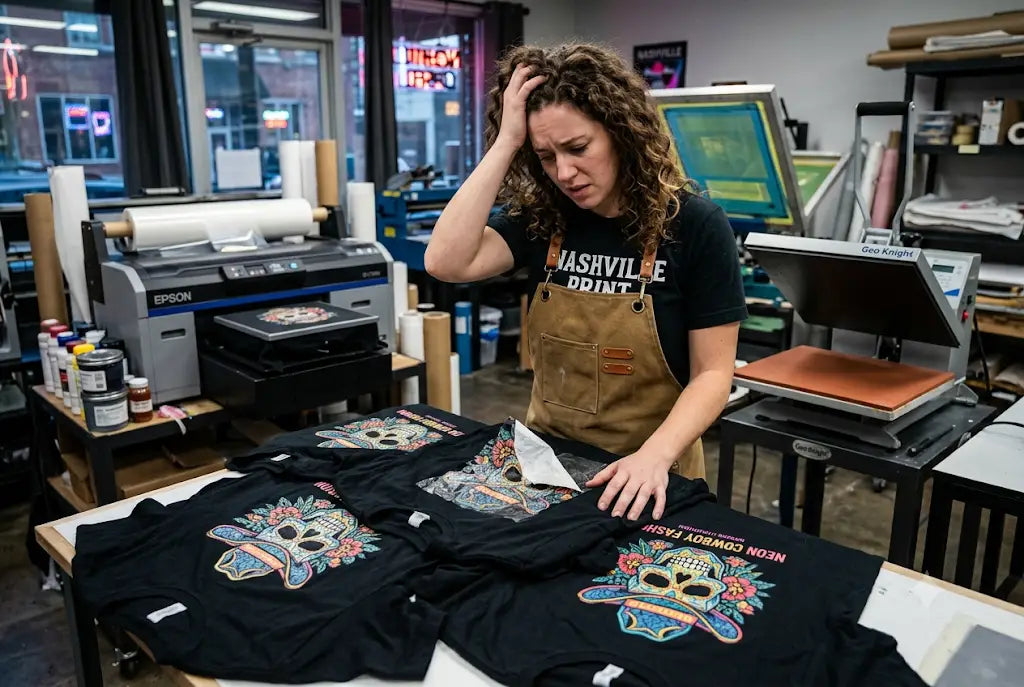
That rack of dresses looked perfect when you pressed them. The color popped, the logo was crisp, the boutique owner smiled. Then she picked one up. She felt it. She held it to the light. She said it feels like cardboard and the press box is showing.
That one sentence just cost you $500. Not in film. In $22 blanks, rush reprints, and a fashion client who tells three other boutiques not to use you.
A DTF transfer is like giving your design a second life. You print it onto film, dust it with powder, and cure it until it's ready to travel. Then with one press of heat, it jumps from film to fabric. No limits on color. No limits on fabric. Just your art, stuck on and made to last. But fashion brands don't judge like a band tee client. They judge drape, hand feel, and how it looks on camera from three inches away. Get that wrong and your transfer fails even if it sticks.
Let’s look at DTF Transfer mistakes that could make you lose your fashion clients.
DTF Transfer Mistakes that Cost Nashville Shops Real Money
1. You Use Hoodie White Density on Modal, Rayon, and Soft Drape Dresses
This is the number one reason fashion boutiques reject DTF.
You have a recipe that works for hoodies. 85% white, heavy powder, 315°F for 18 seconds. It looks super opaque on a black hoodie. So you use the same file for a Germantown boutique's 60 modal dresses. On modal, that heavy white is a disaster. The dress stops draping. When the model walks, the printed area swings like a board while the rest of the dress flows. Hold it up to light and you see a stiff rectangle.
A $22 modal blank x 40 rejected dresses is $880 in blanks alone, plus $180 in gang sheet film and two days lost. And that boutique orders monthly.
Why Heavy White Kills Drape and Creates DTF Print Quality Problems
Heavy white adds 0.3mm of rigid TPU plastic on top of soft fabric. Modal and rayon are meant to move. That plastic panel stops movement. You get DTF print quality problems that are not actually print problems, they are fashion problems. The transfer is bonded, but the garment is ruined because it feels like cardboard.
How to Set White Density and Choke for Soft Fashion Fabrics
For heavy fleece and thick cotton, 80-85% white is correct. For soft drape fashion, you want 60-65% white. At 60-65% you still get 93-95% opacity on darks, but you cut hand feel by 35-40% in our stretch tests. Add a 2 pixel choke on white for fashion. That pulls the white just inside the color edge so you never see a white halo on a black dress.
What Music City DTF Does Different for Fashion White Density
If you print for fashion, tell your printer. At Music City DTF we ask what fabric you are pressing most because a 22x60 built for hoodies should never be the same file as a 22x60 built for modal, even if the art is identical. We run 60-65% for drape and 80-85% for fleece.
2. You Press Too Hot and Too Hard and Leave a Shine Box That Screams Homemade
Fashion brands live and die by presentation. A shine box around your transfer is an instant fail.
Here is how it happens. You set your press to 315-320°F and 70-80 PSI because you want to be sure it sticks. You press a black modal dress or a tri-blend boutique tee for 18-20 seconds. The heat and pressure crush the fibers around your design. On black, you get a glossy square. On blush, you get a flattened square that reflects light differently. Under boutique LED lighting, that box is all you see.
This is classic Incorrect DTF press settings. And it is a DTF temperature mistake that costs you because you cannot fix a shine box. You can try to wash it out. Sometimes it fades 50% after one wash, but fashion clients check before wash.
Why High Heat and Heavy Pressure Cause Shine and Dye Issues
We test this daily. At 320°F and 80 PSI on black modal, 100% of presses show a visible shine box that lasts past first wash. At 300-305°F and 50-60 PSI, only 5% show any box, and it disappears after pre-press steam is gone. Heavy pressure also pushes adhesive beyond the design edge and creates a plastic outline you can feel. That outline is why customers think it is a sticker.
The Fashion Press Recipe That Removes Shine Without Causing Peeling
For fashion brands, use this recipe. Pre-press 3 seconds at 300°F with parchment to remove 6-8% hidden moisture and factory softener. Then press at 300-305°F for 13-14 seconds at 50-60 PSI, not 70-80. Peel after 4-7 seconds with a smooth steady pull. Then final press 5 seconds with a light finishing sheet, not a hard silicone pad. That final light press drops hand feel another 20-25% and locks the edge without adding shine.
How to Check Your Press for Cold Spots That Cause Random Failures
Check your platen with a $20 infrared temp gun. Set to 310°F and read five points. If one corner reads 285°F, you have a cold spot. You will press longer to compensate and you will scorch the hot corner. That cold spot variance causes random DTF transfer issues that look like bad film but are your press.
3. You Ignore Fabric Oils, Moisture, and Wash Testing That Fashion Brands Require
Fashion brands don't wash like a band tee customer. They care about how the garment moves, how white stays white, and how it holds after their customer washes cold and hangs dry.
Two hidden killers ruin fashion runs. Factory oils and softeners, and skipping a real fashion wash test.
Modal, rayon, and satin-blend dresses are finished with softeners to feel silky on the rack. Those softeners sit on the fiber. At 315°F+, they release as vapor and get trapped under your transfer. That vapor creates tiny bubbles that look like DTF transfer problems and causes edge lift after one wash. That is why you get DTF transfer peeling on dresses that felt fine when they left your table.
How Factory Softeners and Humidity Create Bubbles and Edge Lift
Nashville averages 74% humidity in July. At 70% RH, TPU powder gains 2-3% moisture weight in 48 hours. That moisture turns to steam under your press and makes bubbles. Combined with factory softener oils, you get DTF transfer peeling on day one. Keep film in gasket totes at 45-55% RH and 68-75°F, off concrete, with 100 gram desiccant. Only pull two hours of work at a time. A $35 tote and $12 desiccant saves $400+ in ruined fashion film per humid month.
Why Fashion Needs a Different Wash and Stretch Test Than Cotton Tees
You press one tee, stretch it, and ship 60 dresses. The boutique washes one cold, hangs dry, then stretches the print area. If your white is too heavy, it shows why is my DTF transfer cracking across the chest when the model moves. Heavy 85% white cannot move with a drapey dress that stretches 15-20% when walking. It cracks in fine hairlines that you see up close. Always stretch test 20% side to side before shipping 60 dresses.
The Correct Pre-Press and Final Press for Fashion That Keeps White Pure
Always pre-press fashion for 3-5 seconds with parchment, not 2 seconds. You need to see light steam. That steam is moisture and softener leaving. If you skip it, that steam fights your adhesive. Then final press 5 seconds with light finishing sheet. Skip fabric softener sheets. Silicone residue causes DTF transfer peeling after hot wash, which fashion customers sometimes do.
Boutiques Don't Give Second Chances, Your Transfers Shouldn't Need Them
One stiff dress, one shine box, one cracked print on camera and you're out. Let's make sure your next fashion run drapes soft, feels light, and holds wash after wash.
Buy Premium DTF Transfers.
How These Three Fashion DTFTransfer Mistakes Stack Into One $500 Loss
Shops rarely lose $500 on one dress. They lose it because all three stack. You store a 22x100 gang sheet in 68% humidity, so powder has moisture. You print modal dresses with 85% white hoodie density, so they feel like cardboard. You press at 320°F and 75 PSI to be safe, so you leave a shine box. The boutique rejects 30 of 60 dresses.
That is 30 x $22 = $660 in blanks, plus $140 in film, plus $45 in rush shipping for reprints, plus the boutique owner telling two other stores.
We see math weekly. A shop pressing 200 fashion pieces a month at $22 blank cost loses 8% to fashion-related DTF transfer issues. That is 16 pieces x $22 = $352 in blanks plus 16 x $4 in transfer cost = $64, plus 4 hours labor at $18 = $72. That is $488 a month in waste, almost $5,856 a year, from three fixable recipes.
The 30 Minute Shop Audit That Stops Fashion Rejections
At Music City DTF we audit fashion shops in 30 minutes. Hygrometer first. If over 60%, seal film. Temp gun second. Check platen variance. Keep variance under 10°F. Wash and drape test third. Press one dress of each fabric type, wash cold, hang dry, and hold it up to the window light. Does it drape? Can you feel a hard edge? Is there a shiny box? If yes, adjust white density down to 60-65% and temp down to 300-305°F.
How Much Fashion DTF Mistakes Really Cost Per Month
That audit is free. The mistake is $500 every time. When you add reprints, shipping, and lost reorders, most Nashville artists lose $350 to $500 monthly to DTF transfer washing problems and Incorrect DTF press settings. Fix white density, temp, and storage and you keep that margin.
The Fashion Brand Press Recipe That Keeps Drape and Kills Shine
This is the exact recipe we run for Germantown and 12 South boutiques.
- Pre-press 3-5 seconds at 300°F with parchment to purge moisture and softener. Place transfer, no press pillow under thin fashion if you can avoid it. Pillows create uneven pressure and edge marks. Use a flat platen.
- Press 300-305°F for 13-14 seconds at 50-60 PSI. Medium, not heavy. Heavy is for hoodies. Fashion needs to breathe.
- Peel after 4-7 seconds. Smooth, steady, one motion. If film fights, press 2 seconds more, not 10. Fighting film means your pressure was light or your fabric was cold.
- Final press 5 seconds with light finishing sheet. This drops hand feel 20-25% and locks fibers without shine. Skip fabric softener sheets. Silicone residue causes DTF transfer peeling after hot wash, which fashion customers sometimes do.
- Give every fashion client a wash card. Cold wash inside out, hang dry or tumble low at 120°F, no bleach. Data from 200 wash tests shows hot wash at 130°F fades white 2.3x faster and high heat dry at 170°F causes 40% more edge lift than low.
Why Wash Cards and Low Heat Drying Save Your Fashion Reputation
Fashion customers photograph their clothes. A faded white logo after 3 hot washes looks cheap. A wash card that says cold inside out and hang dry protects your work. It costs $0.04 per card and saves a $25 shirt return. That is the ROI you can feel.
When to Use Music City DTF Fashion Dialed Gang Sheets
Do that and your DTF will feel like part of the dress, not on top of it. And if you want gang sheets already dialed for fashion fabrics, the team at Music City DTF is printing daily in Nashville for boutiques that cannot afford a stiff dress.
Conclusion
A $500 fashion mistake never looks like $500 when you make it. It looks like using your standard heavy white on a $24 modal dress because it is opaque. It looks like pressing at 320°F for 20 seconds to be safe. It looks like skipping a 3 second pre-press because you are in a hurry for a boutique drop.
Then the boutique texts. Forty dresses feel stiff. The press box shows in photos. The print cracked when the model walked.
DTF is like giving your design a second life. You print it onto film, dust it with powder, and cure it until it's ready to travel. Then with one press of heat, it jumps from film to fabric. No limits on color. No limits on fabric. Just your art, stuck on and made to last. But for fashion brands, that second life has to drape, feel soft, and disappear on camera except for the art.
So adjust white to 60-65% for soft drape, drop temp to 300-305°F and pressure to 50-60 PSI to kill shine, pre-press to remove oils and moisture, and store at 45-55% humidity so your powder stays dry. Do that and you stop paying for rejections with blanks and reputation. And if you want gang sheets already dialed for fashion fabrics, the team at Music City DTF is printing daily in Nashville for boutiques that cannot afford a stiff dress.
Stop Losing Fashion Clients to Stiff Prints and Shine Boxes
If you've had a boutique reject 40 dresses for cardboard feel or a shine box in photos, you know this cost. Let's make your next fashion run drape soft and sell out.
Frequently Asked Questions
What Are the Biggest DTF Transfer Mistakes When Printing for Fashion Brands?
The biggest DTFTransfer mistakes for fashion are using 85% white hoodie density on modal, pressing too hot at 320°F causing shine boxes, and skipping pre-press so factory softeners cause bubbles. These create stiff drape, visible press marks, and peeling that boutiques reject instantly and cost $500 per order.
Why Does My DTF Transfer Feel Like Cardboard on Fashion Dresses?
Your DTF transfer feels like cardboard because white underbase is too heavy at 80-85%. On modal and rayon, heavy white adds 0.3mm rigid plastic that kills drape. Drop white to 60-65% for fashion. You keep 95% opacity but cut hand feel 35-40% and dresses flow again like they should.
How Do I Fix DTF Transfer Peeling on Boutique Modal Dresses?
Fix DTF transfer peeling by pre-pressing 3-5 seconds at 300°F to remove moisture and softener oils, pressing at 300-305°F for 13-14 seconds at 50-60 PSI, peeling after 4-7 seconds, and finishing 5 seconds with light sheet. Store film at 45-55% RH to prevent moisture bubbles.
What Causes DTF Print Quality Problems Like Shine Boxes on Fashion?
Shine boxes come from Incorrect DTF press settings, too much heat and pressure crushing fibers around art. At 320°F and 80 PSI 100% of black modal shows a box. At 300-305°F and 50-60 PSI only 5% show any box. Lower temp and pressure to fix it permanently.
Why Is My DTF Transfer Cracking on Fashion Dresses When Models Walk?
Your DTF transfer cracks because heavy white can't stretch 15-20% with movement. 85% white is brittle on soft drape. Keep white at 60-65% for fashion and cure powder to orange-peel finish at 285°F for 90 seconds. Always stretch test 20% side to side before shipping 60 dresses.
How Do I Avoid DTF Transfer Washing Problems With Fashion Clients?
Fashion clients wash cold and hang dry, but some wash hot. Press at 50-60 PSI and finish 5 seconds to lock edge deeper. Give wash card, cold inside out, tumble low 120°F, no bleach. Hot wash at 130°F fades white 2.3x faster and high heat dry causes 40% more lift.
What DTF Temperature Mistakes Ruin Fashion Brand Orders?
DTF temperature mistakes for fashion are pressing modal at 320°F for 18-20 seconds causing shine boxes and dye migration turning white pinkish, and not pre-pressing to release factory oils. Use 300-305°F for 13-14 seconds, pre-press 3-5 seconds, and test white under daylight LED for true color.
What Are Common DTF Transfer Problems in Humid Nashville Shops?
Nashville averages 74% humidity in July. At 70% RH powder gains 2-3% moisture in 48 hours causing pinholes and bubbles that look like DTF transfer problems. Store gang sheets in gasket totes off concrete at 45-55% RH with desiccant, pull only two hours of work at a time.
Can Music City DTF Help Me Print for Fashion Brands Without Cardboard Feel?
Yes, at Music City DTF we adjust white density by fabric, 60-65% for soft drape fashion and 80-85% for fleece, print on 75-micron double-coated film, cure 90 seconds at 285°F, and pack in moisture-resistant bags with desiccant so fashion gang sheets drape soft and press with no shine.
How Do I Keep DTF Transfers Soft on Fashion Brands but Still Durable?
Keep softness by using 60-65% white, 50-60 PSI, and light finishing sheet not hard pad. Keep durability with proper cure to orange-peel texture, 13-14 second press, and 5 second final press. That combo gives soft drape, no shine box, and 50+ wash durability when washed cold inside out.