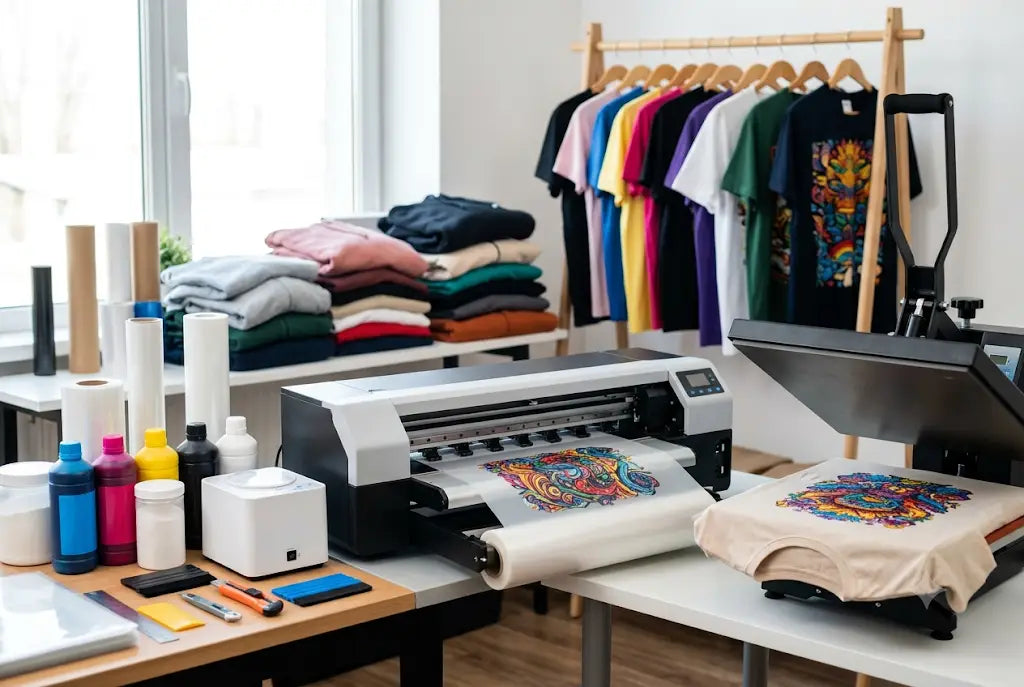
You can clear $6,000 to $12,000 a month with a dtf printing business running part-time in 2026. Full-time shops in Nashville are hitting $25,000 to $40,000 a month. That’s not hype. It’s math. DTF stands for Direct-to-Film, which means you print ink to PET film, add adhesive powder, cure it, and heat press it to a shirt. No screens, no minimums, and you can start taking orders the same day you set up.
If you’re in Music Row or Midtown Nashville wondering if this is worth it, let’s break down the real costs, real revenue, and what it takes to stay profitable without burning through film and ink.
The Real DTF Business Startup Cost In 2026
Let’s talk numbers first because that’s what stops most people. You don’t need a $100,000 shop to start. A reliable desktop DTF printer runs $3,800 to $6,500. Add a powder shaker and curing oven for $1,200 to $2,000. A 16x20 heat press that can hit 325°F consistently is $1,000 to $1,800.
You’ll also need a RIP software license, about $600 a year. Hot peel PET film is $0.35 to $0.50 per A3 sheet. Ink costs roughly $0.08 per square inch. Adhesive powder is $18 per kilo and one kilo covers about 1,200 square feet. Add in blanks, teflon sheets, and a small workspace setup and you’re looking at $9,500 to $14,000 to get doors open.
Compare that to screen printing where you’re dropping $15,000 just on a 6-color press before you buy a single screen. For a dtf printing for small business, the barrier is way lower.
We’ve helped 300+ shops scale, and the ones who start lean in Berry Hill or The Gulch usually break even in 90 days if they sell 200 shirts a month.
Want a starter kit quote for Nashville? Music City DTF puts together printer, film, and ink bundles so you’re not guessing on what to buy.
Monthly Expenses You Can’t Ignore
Startup is one thing. Keeping the lights on is another. Plan for $1,200 to $2,000 a month in fixed costs if you’re running from a small studio in West End or Edgehill. That covers rent, electricity, and software. Variable costs depend on volume. For every 100 shirts you print, expect to spend $320 to $400 on film, ink, and powder. A blank tee costs $3.50 to $5.00 wholesale.
So a shirt that sells for $22 costs you about $8.50 total. That leaves $13.50 in gross profit before labor. If you’re doing this solo after your day job, labor is free. If you hire help in Antioch at $16 an hour, factor in another $2,000 to $3,000 a month. Electric and maintenance add about $150 a month. DTF printers need daily cleaning or they clog. Budget 30 minutes a day for maintenance. Skip it and you’ll spend $400 on a new printhead.
DTF Printing Business Profit: What The Numbers Look Like
This is where people get excited, and where they also get realistic. A single operator with one press can produce 40 to 60 finished shirts in an 8-hour day. That’s with hot peel film, because you don’t wait for cooling between presses. Cold peel would cut that number in half. At $22 per shirt and $8.50 cost, that’s $810 to $1,215 gross profit per day. Run 4 days a week and you’re at $12,960 to $19,440 a month.
But nobody sells 100 percent of what they print. Factor in 15 percent waste and slow days. Realistic monthly net for a solo shop is $6,000 to $10,000. Shops with 2 presses and one employee in Franklin or Mount Juliet are doing $28,000 to $35,000 in revenue and keeping $18,000 to $24,000 after expenses. The key is repeat orders. A bar in Downtown Nashville that orders 50 staff shirts every quarter is worth $2,700 a year to you. Land 10 of those accounts and your baseline is covered.
DTF Printing Market And Demand In 2026
Demand isn’t slowing down. If anything, it’s shifting.
Small brands don’t want 500 shirts. They want 24. Etsy sellers want 1. Tour merch guys want 100 by Friday. That’s where DTF wins.
According to industry reports you can check on IBISWorld, custom apparel printing grew 7.4 percent last year. Most of that growth came from on-demand and short runs. In Nashville, demand is driven by music, events, and local brands. A new single drops and the artist needs merch in 5 days. A brewery in Belle Meade launches a new beer and needs 36 tees. A church in Hendersonville needs youth group shirts.
Screen printers turn those jobs down. You won’t. And because you can print full color with no setup, you can charge $4 to $6 more per shirt than a one-color screen print and still undercut them in small quantities.
How To Start A DTF Transfer Business Without Wasting Money
You don’t need a perfect setup on day one.
You need the right pieces that won’t fight you.Start with a printer that runs real Epson heads. DX5 or DX7 machines cost more upfront, but they hold calibration and you can actually get parts when something goes wrong.
The off-brand heads look like a deal until month 3 when one clogs and you’re down for a week. Next, only buy hot peel film. Press at 325°F for 12 seconds, peel in 3 seconds, and go. Cold peel makes you stand there for 60 seconds on every shirt. Do that 200 times and you’ve lost 3 hours you’ll never get back.Set up somewhere you can vent.
Curing powder has a smell and it builds up fast. A garage in Oak Hill works fine if you’ve got a fan in the window. Pick one RIP and learn it cold. Jumping between three programs slows you down and ruins consistency. And price is like a business, not a hobby. $18 shirts keep you busy and broke. $22 to $26 is where you actually make money and stay open.
Pricing Strategy That Actually Works In Nashville
Nashville customers will pay for speed and quality. They won’t pay for your learning curve.
Base price: $24 for a 12x14 print on a Gildan 5000. Add $3 for 2XL and up. Add $5 for glow, glitter, or puff effects.
Rush fee: 30 percent more for 48-hour turnaround. Artists on Music Row pay it every time.
Wholesale: $14 per shirt for orders over 100. You still make $5.50 and the volume keeps your printer running.
Track everything. If a job takes you 20 minutes and nets $40, that’s $120 an hour. If it takes 45 minutes, you need to charge more or streamline.
Common Costs That Eat Your Profit
We see this in Murfreesboro and Brentwood shops all the time.
Cost 1: Bad film. Cheap film from overseas might save $0.10 a sheet but it jams and ruins $200 in ink. Buy consistent hot peel from a US supplier.
Cost 2: Reprints. If you don’t do a wash test, you’ll reprint 10 shirts for free. Test one, wash it 5 times, then run the job.
Cost 3: Ink waste. Shake your white ink daily. White settles and clogs. A clogged head is $350 plus downtime.
Cost 4: Underpricing. If you’re charging $15 a shirt, you need to sell 600 a month just to make $6,000. At $24, you only need 375.
Scaling From Side Hustle To Full Shop
Month 1-3: Goal is 150 shirts. That’s about $2,000 profit. Reinvest in more film and a second press.
Month 4-6: Target local businesses. Walk into 5 shops in The Gulch with samples. Offer 24-hour turnaround.
Month 7-12: Hire part-time help. Add embroidery or UV DTF to increase average order value.
By year 2, shops we’ve consulted are doing $300,000 to $450,000 in annual revenue with 2-3 employees. Profit margins sit around 35 to 40 percent because overhead stays low.
The difference between shops that make it and shops that don’t is simple. The winners treat it like a business, not a printer in the corner.
Conclusion
A DTF printing business in 2026 comes down to two things: your cost per print and how fast you can turn a design into a shirt. The equipment is a fixed cost. After that you’re looking at about $3 to $5 in film, ink, and powder per tee, and most shops sell between $20 and $28. Run 100 shirts a week and you’ve got solid side income. Push 300 and it starts paying the bills. Hit 500+ with gang sheets and you’re scaling. But speed matters more than volume.
If it takes you two days to get art to press, the trend is dead. If you can go from file to finish in 20 minutes, you catch it while people are still posting about it.That’s why we built this breakdown. We run presses every day at Music City DTF, and we know where the money leaks: wasted film, reprints from bad curing, and outsourcing art you could do in-house. Lock in your numbers, price with margin, and use a workflow that keeps you moving.
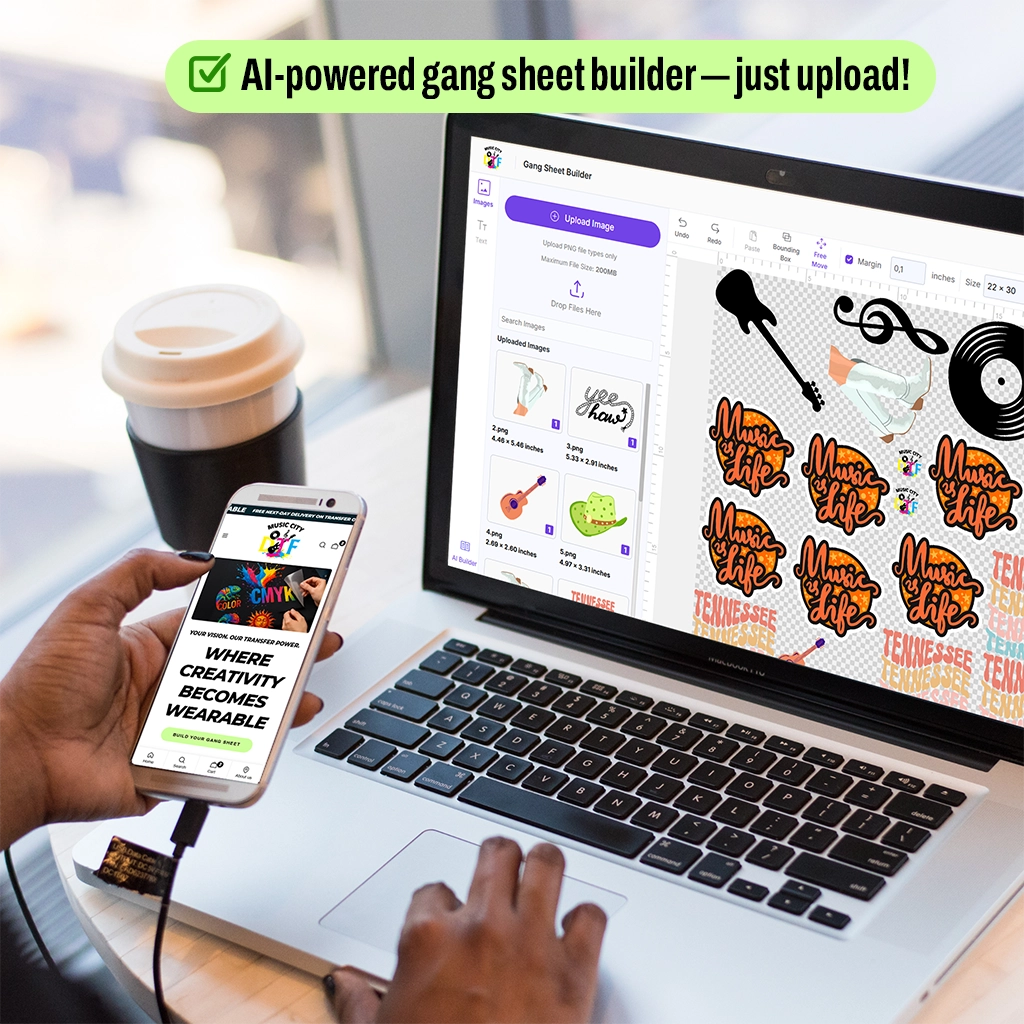
Start exploring the Music City DTF Gangsheet Builder today. Upload, arrange, and print more on every sheet so you keep more profit on every order.
Frequently Asked Questions
Is A DTF Printing Business Profitable In 2026?
Yes. A solo dtf printing business can net $6,000 to $10,000 a month working 4 days. With 2 presses and wholesale accounts, shops clear $18,000 to $24,000 monthly. Profit depends on pricing, speed, and repeat customers.
What Is The DTF Business Startup Cost?
Expect $9,500 to $14,000 to start. That covers printers $3,800 to $6,500, presses $1,000 to $1,800, shaker $1,200, software $600, and initial supplies. You can start smaller, but don’t skip hot peel film or a reliable press.
How To Start A DTF Transfer Business From Home?
Get a desktop printer, powder shaker, and heat press. Set up in a ventilated garage. Buy hot peel film and learn one RIP. Start with 20 shirts for friends. Sell on Etsy and Instagram. Reinvest profit into better equipment.
How Much Can You Make Per Shirt With DTF?
Average cost is $8.50 per shirt including blank, ink, and film. Sell for $22 to $26. That’s $13.50 to $17.50 gross profit. Rush jobs and 2XL sizes add more. Volume orders drop profit per piece but increase total cash.
What Is DTF Printing Demand Like Right Now?
Demand is high for short runs. Brands want 24 shirts, not 500. Events, concerts, and local businesses in Nashville need 5-day turnaround. Screen shops can’t do that profitably. DTF fills that gap and charges a premium for speed.
Do I Need Cold Peel Or Hot Peel For Profit?
Use hot peel. It releases in 3 seconds so you can press more shirts per hour. Cold peel makes you wait and kills production speed. For a profitable dtf business, speed is money and hot peel gives you that speed.
Can Music City DTF Help Me With Supplies?
Yes. Music City DTF sells hot peel film, ink, and powder to shops in Nashville, Brentwood, and Franklin. We also help with press settings and troubleshooting so you don’t waste money on bad prints during your first 90 days.
What Mistakes Kill DTF Printing Business Profit?
Underpricing, using cheap film, and skipping maintenance. A clogged head costs $350. Reprints kill margins. Charge $22 minimum, buy quality supplies, and clean your printer daily. Track time per job so you know your real hourly rate.
How Many Shirts Can One Person Print In A Day?
With one press and hot peel, 40 to 60 shirts in 8 hours. That includes design, printing, and pressing. Add a second press and you hit 90 to 110. Speed comes from workflow, not from working faster.
Is DTF Better Than Screen Printing For Small Orders?
Yes. Screen printing needs screens and setup fees. DTF has zero setup. For orders under 100 pieces, DTF is faster and more profitable. For 500 plus, the screen printing method may be cheaper. Most shops in 2026 are running both.