Hyper + is widely used in apparel-heavy production where wash resistance, fabric bonding strength, and repeat order consistency matter. UV DTF, on the other hand, is used for sticker production, packaging labels, and rigid surface branding where speed and visual impact are more important than long-term fabric durability.
These systems are often placed side by side in conversations, but in real production they solve completely different problems. The challenge for most shops is not choosing the “better” system; it is understanding where each one performs without creating unnecessary rework or quality issues in the workflow.
Hyper + Definition
In DTF printing, Hyper+ refers to an advanced color mode that uses more ink channels to produce richer, more vibrant and accurate prints. It enhances gradients, detail, and color depth, allowing smoother transitions and improved image quality for textile printing applications use.
What Hyper+ does in production
Hyper + focuses on controlling ink behavior, transfer stability, and fabric bonding strength under heat press conditions. It is designed for structured garment workflows where consistency is more important than experimentation.
Production behavior overview (fabric-focused stability)
|
Factor |
Hyper + |
Standard DTF |
|
Ink stability across runs |
High consistency |
Medium variation |
|
Fabric penetration depth |
Strong fiber bonding |
Surface-level bonding |
|
Fine detail retention |
Strong on textiles |
Can soften on dark garments |
|
Wash resistance |
High durability |
Medium durability |
|
Batch repeat accuracy |
Very consistent |
Moderate variation |
This comparison shows why Hyper+ is often selected for structured apparel production rather than experimental or short-run printing environments.
Why consistency matters in apparel workflows
In real shop environments, the biggest issue is not whether a design prints—it is whether it prints the same way every time. Hyper+ reduces variation between batches, which is critical for uniform programs, retail apparel drops, and repeat branding orders where customers expect identical results across months or even years.
Fabric performance in real-world use conditions
On cotton, polyester, and blended garments, Hyper Plus integrates more deeply into fabric layers. This reduces surface cracking, fading, and peeling that can appear after repeated wash cycles. In high-usage apparel like uniforms or sportswear, this durability difference becomes noticeable over time.
Where UV DTF fits in production workflows
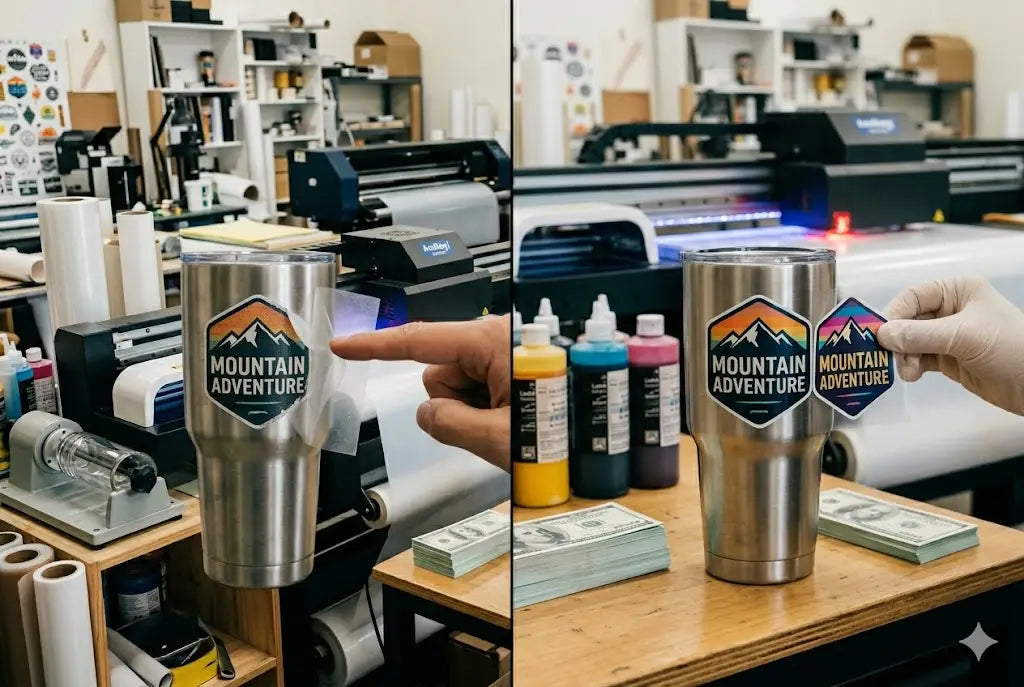
UV DTF is built for rigid surfaces and does not compete directly with fabric-based systems. Its strength lies in adhesive film application and fast surface branding.
UV DTF workflow comparison (application-based system)
|
Factor |
UV DTF |
Hyper + |
|
Surface type |
Glass, plastic, acrylic |
Fabric only |
|
Application method |
Peel-and-apply adhesive film |
Heat press transfer |
|
Setup complexity |
Low |
Medium |
|
Production speed |
High for stickers |
Moderate for apparel |
|
Equipment requirement |
Minimal |
Heat press required |
This difference alone explains why many shops run both systems instead of choosing one.
Why shops adopt UV DTF for sticker production
UV DTF is widely used because it simplifies production for stickers, labels, and packaging. The absence of heat pressing reduces setup time, allowing faster turnaround on small batch orders and promotional materials.
Visual output and finish characteristics
UV DTF produces a glossy, high-contrast finish that works well on retail packaging, bottles, and promotional items. However, this finish is designed for visual appeal rather than long-term fabric durability or wash resistance.
Order your UV DTF Transfers today to test durability.
Durability comparison that impacts real business decisions
Durability is often the deciding factor for Nashville print shops, especially when handling repeat customers or bulk apparel orders.
Durability performance breakdown table
|
Durability factor |
Hyper+ |
UV DTF |
|
Fabric wash resistance |
High performance |
Not applicable |
|
Outdoor exposure stability |
Moderate-high |
Medium |
|
Friction resistance |
High |
Medium-low |
|
Long-term clarity |
Strong |
Moderate |
|
Batch durability consistency |
High |
Medium |
Why Hyper Plus performs better on apparel
The key advantage comes from deeper bonding into fabric fibers. Instead of sitting on the surface, the ink integrates into the textile structure, which reduces cracking and peeling over time even after multiple wash cycles.
UV DTF wear behavior over time
UV DTF performs well initially but can show wear depending on handling, environmental exposure, and surface conditions. Items that are frequently touched, washed, or exposed to friction may experience reduced clarity over time.
Print quality differences across materials
Print quality is not absolute—it depends entirely on the surface being printed.
Quality comparison table (material-dependent output)
|
Quality factor |
Hyper+ |
UV DTF |
|
Color consistency on apparel |
High |
Not applicable |
|
Color intensity on rigid surfaces |
Medium |
High |
|
Finish type |
Fabric-integrated matte look |
Glossy finish |
|
Fine detail reproduction |
Strong on textiles |
Strong on smooth surfaces |
|
Brand consistency across batches |
High |
Medium |
Apparel color stability advantage
Hyper Plus provides tighter control over color consistency across garments, which is critical for branded uniforms and retail apparel lines where exact color matching defines product quality.
UV DTF gloss and visual impact
UV DTF enhances surface visuals through a glossy finish that improves shelf appeal. This is particularly effective in packaging and promotional branding environments.
Cost comparison in real production environments
Cost is not just equipment—it is waste, reprints, and operational efficiency over time.
Cost structure comparison table
|
Cost factor |
Hyper + |
UV DTF |
|
Startup investment |
Higher |
Lower |
|
Material efficiency |
Higher long-term efficiency |
Moderate efficiency |
|
Reprint frequency |
Lower |
Higher in some cases |
|
Workflow complexity |
Medium |
Low |
|
Long-term profitability (apparel) |
High |
Medium |
Why UV DTF has lower entry barriers
UV DTF is easier for new shops to adopt because it requires less equipment and fewer setup steps. This allows entry into sticker and packaging markets without heavy initial investment.
Why Hyper Plus reduces long-term cost loss
Although setup is more structured, Hyper + reduces failed prints and rework in apparel production. Over time, this leads to lower material waste and higher profitability in bulk garment workflows.
How Nashville print shops actually divide usage
In real operations, most Nashville print shops do not rely on a single system. They divide production based on product type and customer demand.
Real workflow structure inside shops
Most shops separate production lines internally. Apparel jobs are processed through Hyper+ workflows, while sticker and packaging orders move through UV DTF systems. This separation reduces bottlenecks and improves efficiency.
Which system should you actually choose
The correct choice depends on product focus, not general performance comparisons.
-
Apparel-focused business → Hyper Plus
-
Sticker and packaging-focused business → UV DTF
-
Mixed production business → combined system approach
Most growing shops eventually adopt both systems because customer demand naturally expands beyond a single category.
Final perspective on both systems
Hyper+ and UV DTF are not competing technologies—they are production tools built for different surfaces and business models.
In Nashville print environments, success comes from understanding where each system performs best rather than forcing one to replace the other. Shops that scale efficiently tend to align production systems with product types instead of trying to standardize everything under a single workflow.
Start exploring DTF printing solutions at Music City DTF.
FAQs
1. What is the main difference between Hyper+ and UV DTF?
Hyper+ is designed for fabric-based apparel printing, focusing on ink bonding into textiles for durability and wash resistance, while UV DTF is used for rigid surfaces such as glass, plastic, and coated materials, making it more suitable for stickers, labels, and product branding applications.
2. Which system is more durable for clothing?
Hyper+ is more durable for clothing because it bonds directly into fabric fibers during heat transfer, improving wash resistance, flexibility, and long-term wear performance compared to surface-based printing methods that may crack or fade over repeated washing cycles.
3. Is UV DTF only used for stickers?
Yes, UV DTF is mainly used for stickers, labels, and packaging applications rather than apparel or fabric printing. It is designed for rigid or semi-rigid surfaces, making it ideal for product branding, decorative labels, and promotional materials used across commercial industries.
4. Why do print shops prefer Hyper Plus?
Print shops prefer Hyper+ because it delivers consistent color output and stable results in bulk apparel production. It reduces variation between repeated print runs, improves efficiency, and ensures reliable quality control for uniforms, merchandise, and branded clothing orders.
5. Which system has lower startup cost?
UV DTF has a lower startup cost due to simpler equipment requirements, fewer production steps, and less material complexity. It is often chosen by beginners or small print businesses looking to enter the market with sticker and label production before expanding into apparel printing.
6. Can both systems be used together?
Yes, many print shops use Hyper+ for apparel and UV DTF for stickers and packaging. This combined approach allows businesses to expand their service offerings, target multiple markets, and increase revenue streams through both fabric printing and rigid surface branding solutions.
7. Which system is better for Nashville print shops?
It depends on the business model. Apparel-focused shops in Nashville benefit more from Hyper + due to demand for uniforms and clothing, while sticker-focused shops perform better with UV DTF for packaging, branding, and promotional product customization services.
8. Does UV DTF perform well outdoors?
UV DTF performs reasonably well outdoors but may degrade over time depending on exposure to sunlight, moisture, and handling conditions. Its durability is suitable for short to medium-term applications, but long-term outdoor performance varies based on environmental stress.
9. Is Hyper Plus suitable for bulk orders?
Hyper+ is widely used in bulk production because it maintains consistent color output, strong adhesion, and reliable quality across large apparel runs. It is especially effective for uniforms, promotional clothing, and commercial textile manufacturing.
10. What is the best setup for new print shops?
Most new print shops start with UV DTF due to lower startup cost and simpler workflow, then expand into Hyper + as they grow into apparel production, allowing them to offer both sticker-based products and full garment printing services.