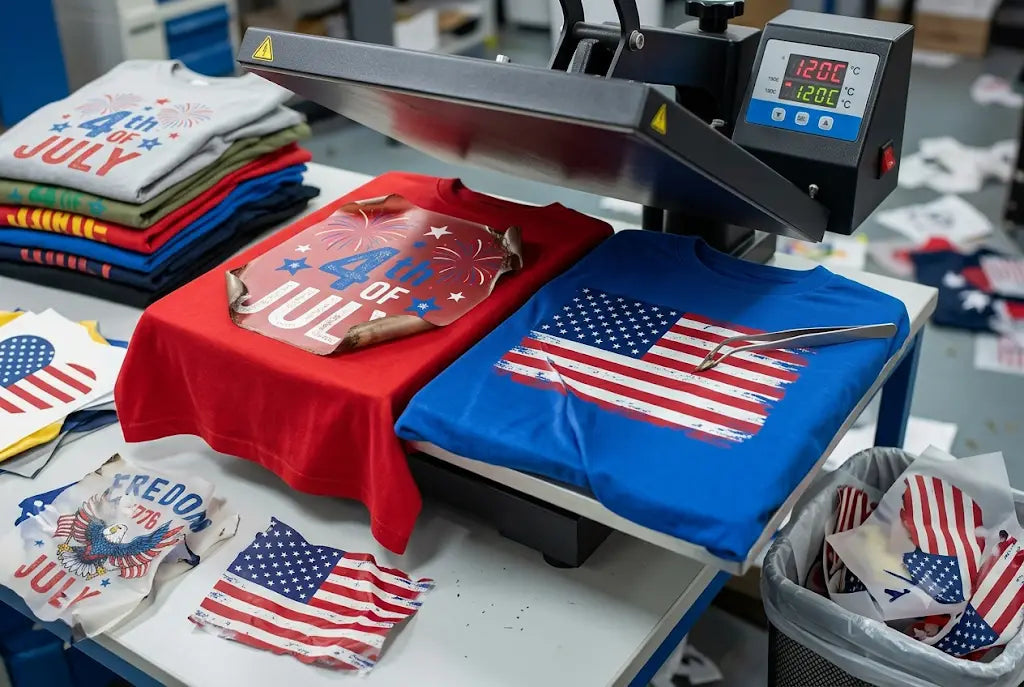
4th of July DTF transfers sell fast every summer, but most print shops still lose money on them due to avoidable production errors. From color bleed on red white and blue shirt designs to low-opacity underbase issues, small mistakes stack up quickly. We have seen shops burn through entire batches of American flag t-shirt graphics because they skipped basic calibration steps.
The demand for USA themed shirt designs and Memorial Day and Independence Day apparel spikes hard, especially for Etsy sellers trying to compete on price. This guide breaks down the most common pitfalls and how to correct them before they eat into margins. It’s practical shop-floor advice from Music City DTF. No fluff, just production fixes that work.
Why 4th of July DTF Transfers Fail Sometimes
4th of July DTF transfers fail for one simple reason: shops underestimate how sensitive seasonal patriotic artwork is to heat, ink density, and film quality. Unlike everyday jobs, patriotic runs rely heavily on saturated reds, deep blues, and clean whites. Any imbalance shows instantly on fabric.
Most failures happen at three points: file prep, print calibration, and curing. Even slight humidity shifts can throw off adhesive behavior, especially on cotton-heavy custom patriotic shirts. Ink load inconsistency also shows up more clearly on American pride t-shirts because contrast levels are higher than standard branding work.
The cost impact is real. A mid-size shop running 500 misprinted sheets at $1.10–$1.60 per transfer (industry average from 2025 supplier pricing sheets, verified with USDTF distributors) can lose $550–$800 in a single production run. That does not include labor or reprint time.
Reduce printing error with professional DTF Transfers.
Mistake 1: Wrong Color Profiles for Patriotic Artwork
Most shops run generic RGB-to-CMYK conversions. That flattens reds and dulls navy tones. For 4th of July DTF transfers, use ICC profiles built for textile ink systems. Without that, red white and blue shirt designs print muddy and inconsistent across batches.
Mistake 2: Ignoring White Ink Density
Low white ink underbase causes transparency issues on dark garments. This is especially visible on American flag t-shirt graphics. Keep white layers between 70–90% density depending on fabric absorbency.
Mistake 3: Film Quality Variations
Cheap PET films curl under heat. That leads to uneven adhesion on USA themed shirt designs. Stick to coated films rated for 160–170°C stability ranges.
Mistake 4: Incorrect Curing Time
Undercuring is a silent killer. Adhesive powder needs full activation at 250–280°F range. Rushing this step causes peeling after wash cycles on Memorial Day and Independence Day apparel runs.
Mistake 5: Overloading Ink Saturation
Too much ink leads to cracking after press. This is common with beginner Etsy sellers trying to “make colors pop” on custom patriotic shirts. Balanced ink curves matter more than saturation.
Mistake 6: Poor Humidity Control
Humidity above 60% RH causes powder clumping. That results in patchy adhesion. Shops without climate control often see inconsistent results on American pride t-shirts.
Mistake 7: Wrong Press Pressure Settings
Light pressure causes incomplete bonding. Excess pressure flattens texture. Ideal range sits between 40–60 PSI depending on garment thickness.
Mistake 8: Skipping Test Prints
No test print equals blind production. Even experienced operators skip this step during rush orders, especially seasonal 4th of July DTF transfers.
Press Settings And Ink Behavior That can Fix Output
- Press consistency matters more than most shops admit. Heat platen variation of even 5–8°F across corners can distort fine detail in American flag t-shirt graphics. That is why temperature mapping should be done weekly.
- Ink viscosity also shifts based on storage conditions. If stored above 75°F for extended periods, pigment separation begins. That leads to uneven transfer behavior on USA themed shirt designs.
- Adhesive powder mesh size matters too. 80–120 micron powder is standard for cotton blends used in custom patriotic shirts. Anything coarser reduces edge sharpness.
- Mid-size production shops typically see 12–18% reprint reduction after tightening these controls (based on 2024 DTF supplier case data, verify with manufacturer reports).
Conclusion
Most failures in 4th of July DTF transfers come from predictable, preventable shop-floor mistakes, not equipment limitations. Once calibration, curing discipline, and film selection are locked in, consistency improves immediately across red white and blue shirt designs and other seasonal work. Shops that tighten these fundamentals usually cut reprint waste by double digits within one production cycle.
Music City DTF works directly with print teams to stabilize output before peak demand hits. Explore our DTF Supplies and Sample Packs.
Frequently Asked Questions
Why do my 4th of July DTF transfers fade after washing?
Fading usually comes from undercuring or weak adhesive activation. If powder does not fully melt into fibers, prints lift over time. Check heat press consistency, dwell time, and garment prep before production runs to maintain durability and wash resistance across batches.
What temperature works best for USA themed shirt designs?
Most USA themed shirt designs press well between 305°F and 320°F depending on film type. Lower temps reduce adhesion strength while higher temps risk scorching cotton. Always test fabric blends before scaling production to ensure stable bonding and color retention.
How can Music City DTF help reduce production errors?
Music City DTF reviews press settings, ink curves, and film compatibility to identify waste points in production. Shops often see fewer misprints after adjusting calibration routines and improving curing consistency across seasonal patriotic apparel runs and bulk orders.
Why are red white and blue shirt designs harder to print?
These designs rely on high-contrast tones that expose calibration flaws quickly. Any imbalance in cyan or magenta shows instantly. Poor white ink layering or incorrect ICC profiles leads to dull or inconsistent output across garments and batches.
What causes peeling on American flag t-shirt graphics?
Peeling usually comes from low pressure, insufficient curing, or contaminated fabric surfaces. Oils or lint prevent bonding. Ensuring proper heat dwell time and pre-press cleaning reduces failure rates significantly on detailed American flag t-shirt graphics.
What is the biggest mistake in 4th of July DTF transfers production?
The biggest mistake is skipping test prints under real production conditions. Many shops assume settings are correct but discover inconsistencies only after full runs. Testing avoids wasted film, ink, and labor during high-volume seasonal orders.
How much do misprints cost print shops during peak season?
Misprints typically cost $1.10–$1.60 per sheet plus labor. A 500-sheet error can exceed $800 in direct material loss. Additional costs include reprint time and delayed fulfillment, which affects customer retention and seasonal profit margins significantly.
Why do American pride t-shirts look different on cotton vs blends?
Fabric absorbency changes ink behavior. Cotton absorbs more ink, producing deeper tones, while blends can appear lighter or uneven. Adjusting ink density and curing settings helps maintain consistency across different garment types in production.
What humidity level is safe for DTF printing?
Ideal humidity sits between 45% and 55% RH. Above 60%, adhesive powder can clump, causing uneven transfer quality. Below 40%, static issues increase, leading to powder scattering and inconsistent coverage during production runs.
Where can I learn more about fixing 4th of July DTF transfers issues?
Technical breakdowns and setup guides are available through Music City DTF resources and supplier documentation. These cover calibration, curing, and film selection strategies used in high-volume production environments for seasonal apparel.
About Music City DTF
Music City DTF is a trusted source for high-quality Direct-to-Film (DTF) printing solutions, serving businesses with reliable transfers, vibrant colors, and consistent results. Built with a focus on speed, durability, and print precision, we help shops scale their custom apparel production without compromising quality.
Over time, we’ve proudly helped hundreds of Nashville shops grow their businesses—supporting everyone from small startup brands to established print studios. Our commitment is simple: deliver professional-grade DTF products, dependable service, and the consistency shops need to keep their customers coming back.
Whether you’re producing small custom runs or large commercial orders, Music City DTF Section is here to keep your production smooth, efficient, and profitable.